The Spark journal · Learning Through Play
Calm car rides happen when the road becomes the game.
Strapped into a forward-facing car seat with little to hold and no way to stretch, 3- to 5-year-olds quickly lose patience with ‘Are we there yet?’ A handful of hands-free window games, sound stories, and rhythmic pauses turn miles into genuine connection.
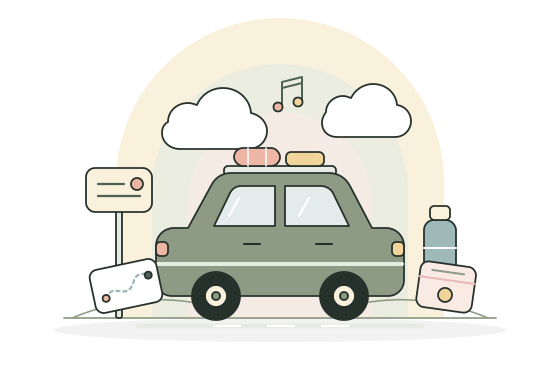
Picture a long afternoon drive between towns—or even a twenty-five-minute errand loop after school. Forty minutes into the trip, a four-year-old strapped snugly into a backseat harness kicks the back of the passenger seat, drops their water cup onto the floorboard out of reach, and asks for the fifth time whether you are almost there yet. In the front seat, a parent watching the road wonders if handing back a phone is the only way to bring peace to the cabin.
That backseat moment is an illustrative example rather than a story about an individual student, and almost every family recognizes how fast the mood in a car can shift. When preschoolers fuss on a drive, they are rarely trying to derail the trip. Their energetic bodies are buckled tightly in place while their brains try to make sense of miles that look nearly identical out the side window.
The encouraging news is that keeping a three-, four-, or five-year-old engaged in the car does not require a seat-back screen or a crate of hard plastic toys rolling under the pedals. The passing scenery, your voice, and your child’s own imagination can carry the drive with zero extra gear.
Why car rides feel especially long for 3- to 5-year-olds.
Sitting in a moving vehicle asks a preschooler to do several developmentally demanding tasks at the exact same time:
- Still bodies crave sensory input: Three- to five-year-olds are wired to learn through movement. Being harnessed in one position restricts big muscle play, so restlessness shows up quickly as wiggling, seat-kicking, or loud chatter.
- Distance and time feel invisible: Saying "Forty-five more minutes" means very little when a child cannot picture how long forty-five minutes lasts. Concrete landmark milestones ("When we pass two bridges and stop for gas, we will be at Grandma’s street") give their brain a steady anchor.
- Looking down can upset young tummies: Many children feel mildly carsick before they ever know how to name nausea—showing yawns, sudden crankiness, or a pale face instead. Staring down at a tablet, coloring pad, or book keeps their eyes fixed on stillness while their inner ear feels every curve and bump. Games that lift eyes up and out the window protect comfort as well as attention.
At ages three, four, and five, children are naturally growing the exact conversational and thinking skills that make backseat games click. As the CDC’s Learn the Signs. Act Early. milestones describe, three-year-olds start holding back-and-forth conversations of two or more exchanges, four-year-olds delight in telling stories and pretending, and five-year-olds practice taking turns and playing simple games with rules.
Why looking up, listening close, and allowing quiet beats constant entertainment.
In a car, parents and children face the same direction, which removes the eye contact you naturally rely on at home. Even without looking face-to-face, warm back-and-forth voice exchanges—what the Center on the Developing Child at Harvard University calls serve and return—keep a child feeling connected and emotionally steady.
Just as reassuring, HealthyChildren.org’s road trip play guidance from the American Academy of Pediatrics (AAP) reminds families that you do not need to fill every single mile with structured entertainment. Letting preschoolers gaze out the window, hum to themselves, or sit in quiet daydreaming teaches them how to settle without leaning on a screen at the first sign of boredom.
A 2-minute highway worked example: The Cargo Truck Mystery
Before reaching for a backup playlist or device on your next drive, try this zero-prep conversation starter the moment a large truck or delivery van passes by:
- Notice the shared cue together: "Whoa, look at that big white box truck passing us on the left!"
- Invite an imaginative guess: "What do you think could be packed inside that truck? Five hundred bouncy balls, boxes of blueberries, or a giant sleeping dinosaur?"
- Build on their answer for two more turns: When your child picks or invents something wild—"Marshmallows for hot cocoa!"—follow their lead: "Ooh, where is the truck driver taking all those marshmallows, and who is going to help unload them?"
In two unhurried minutes, your child practices expressive storytelling, sustained attention, and turn-taking—all while keeping their eyes lifted toward the road ahead and your hands safely on the wheel. That same conversational warmth sits at the center of purposeful play in everyday life.
Seven screen-free car and road trip games for ages 3 to 5.
Every game below is driver-safe (hands-free, eyes on the road, zero props to hand back), requires no loose objects in the backseat, and adjusts easily for shorter errands or multi-hour trips.
1. Out-the-Window "I Spy" by Clue (Not Just Color)
Classic color I Spy loses steam quickly on an open highway. Switch to clues about shapes, sounds, or what something does:
- "I spy something tall and spinning that catches the wind." (a wind turbine or pinwheel)
- "I spy something with big round tires that helps build roads."
- "I spy something bright in the sky that looks like a spoon."
Give your child a turn to invent clues too—even if their clue gives the answer away right away ("I spy a yellow school bus!"), celebrate the turn and guess playfully.
2. Preschool Category Relay (No Elimination)
Older-kid category games often knock players out when they pause too long, which brings quick tears at age three or four. Keep the relay cooperative instead: pick a concrete topic—breakfast foods, animals with tails, things that have wheels, or things that are cold—and see how many ideas the whole car can collect together before the next exit sign.
Categorizing words strengthens vocabulary and mental flexibility, two pillars of early literacy without flashcards and kindergarten readiness.
3. Audio Finger-Plays & "Silly Wrong Word" Songs
As HealthyChildren.org highlights, classic action songs like The Wheels on the Bus and The Itsy Bitsy Spider keep busy preschool hands occupied right inside a car seat. Once your child knows a favorite verse well, sneak in one delightful mistake ("The wheels on the bus go... banana, banana, banana!") and wait for them to catch you and fix the lyrics.
4. Cloud Sculptures & Sky Stories
When traffic slows or stretches through flat countryside, invite everyone to look up through the windshield or side windows toward the clouds: "Do you see a cloud shaped like a whale, a fluffy dog, or a slice of pizza?" Looking toward the sky keeps eyes near the horizon—especially helpful for children prone to car sickness—while inviting open-ended imagination.
5. "Copy That Sound" & Backseat Echoes
Pick a sound you can make with just your voice—a gentle rainstorm (shhhhh), a bumpy tractor engine (chug-chug-chug), a tiny mouse squeak, or a three-clap rhythm—and let your preschooler echo it back. Then trade roles so your child becomes the sound leader for the whole car. Active listening and auditory memory skills grow effortlessly through sound play, supporting the working memory highlighted in the Harvard Center on the Developing Child executive function guide.
6. First-Letter Sign Hunt (Ages 4–5)
For older preschoolers who are starting to notice letters in the world around them, turn roadside billboards, exit signs, and license plates into a calm treasure hunt: "Let’s see if we can spot the first letter of your name three times before our next stop." Keeping the target to one meaningful letter (theirs, M for Mom, or S for Stop) keeps the hunt joyful rather than overwhelming at highway speed.
7. Three-Turn Road Story Builder
Start a tiny, travel-sized adventure and hand the microphone back and forth around the car:
- You: "Once upon a time, a little green frog packed a tiny backpack and hopped into a minivan heading for..."
- Your child: "The ice cream store!"
- You: "When the frog opened the door, there was a line of penguins waiting to order..."
Let the story wrap up happily in four or five turns so it stays crisp and funny instead of dragging on.
Packing light and planning breaks that actually reset everyone.
Games work far better when a preschooler’s basic physical comfort and car-seat safety are already set up for success. Following the AAP’s Tips for Safe & Stress-Free Family Travel and Holiday Travel Safety Tips keeps long drives calmer and safer:
- Keep cabin items soft and lightweight: Hard toys, heavy plastic trays, or loose metal cups can become unsafe in a sudden stop—and anything dropped out of reach turns into an immediate backseat frustration. Pack soft plush companions, lightweight board or cloth books, or a single flat clipboard only when your child wants a quiet break.
- Use thin, warm layers in winter: Puffy winter coats create hidden slack under car-seat harness straps. Dress your preschooler in snug fleece or knit layers, buckle the harness tightly, and tuck a warm blanket over the buckled straps instead.
- Stop roughly every two hours: Plan short stretch-and-bathroom breaks every two hours during daytime drives. Five minutes of hopping like frogs beside a picnic table or running a quick loop at a safe rest area resets little nervous systems better than pushing straight through.
- Save one phone quick-sheet before you pull out of the driveway: Download our free Spark on the Go Starter Pack — 10-page PDF before your trip. Alongside two car-ride missions you can open in ten seconds, it covers four other everyday bottlenecks—restaurants, grocery carts, waiting rooms, and dinner prep—plus two printable play mats.
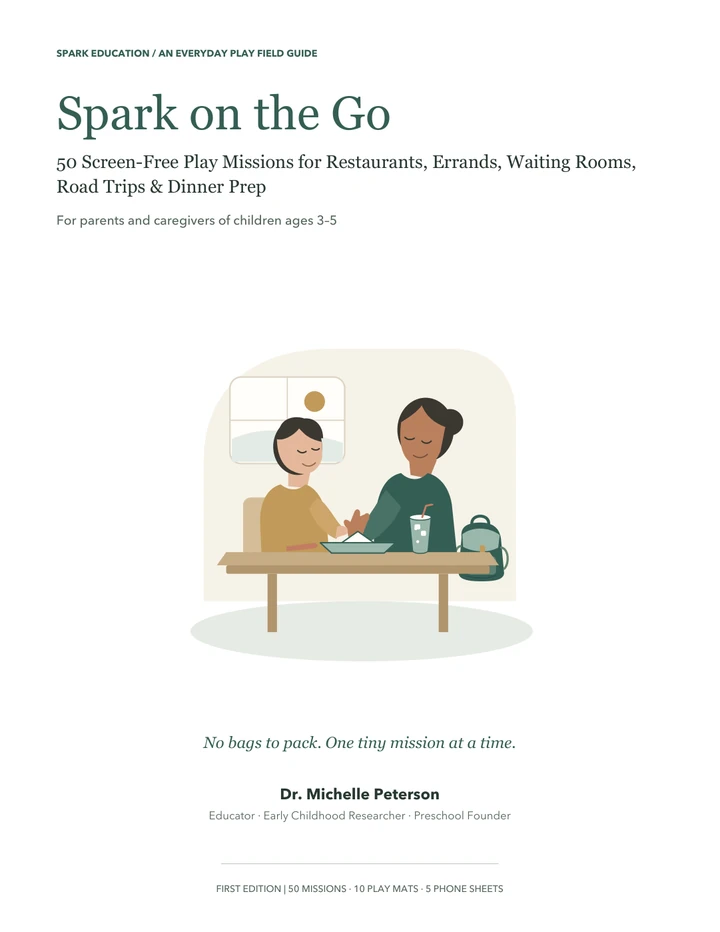
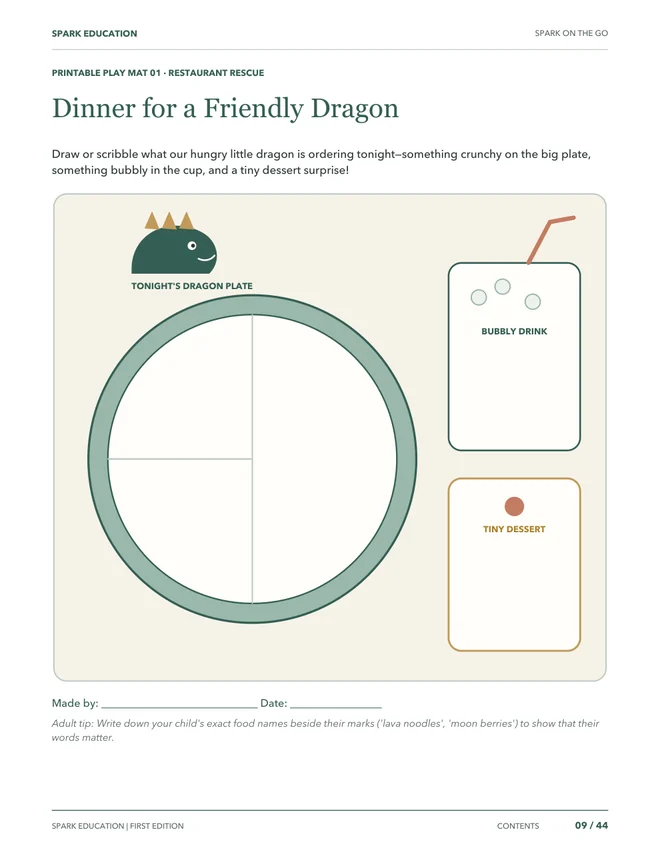
For families who want a whole travel and errand toolkit ready year-round, Dr. Michelle Peterson’s 44-page Spark on the Go ($9.95) gathers 50 screen-free missions across those five everyday settings, 10 printable play mats, and 5 one-page phone quick-sheets. You can also pair road-trip outings with our guide to screen-free restaurant activities for preschoolers or find calm transition wording in Preschool Parenting Scripts ($4.95, 20 pages)—or explore all five family guides together in the Preschool Play & Readiness Collection ($24.95, saving $23.80).
Questions families ask about screen-free car rides with preschoolers.
How do I keep a 3-year-old entertained without handing over a tablet every drive?
Start small on short 10- to 15-minute errands rather than waiting for a six-hour holiday trip. When your child gets used to playing Copy That Sound, singing silly-word songs, or spotting yellow trucks on everyday rides to preschool or the store, longer drives feel familiar instead of empty without a screen.
What if my preschooler gets carsick during car activities?
Skip anything that asks your child to look down inside the cabin—including books, coloring sheets, and handheld devices. Stick to voice-only games (Category Relay, Copy That Sound, Pass-the-Story) and horizon-level games like Cloud Sculptures. Offering light, plain snacks before travel, keeping fresh cool air circulating, and checking in with your child’s pediatrician if motion sickness happens often can also make trips much smoother.
Do these car games work for short daily drives as well as long road trips?
Yes—in fact, short drives are where these games shine most. A two-minute Cargo Truck Mystery or First-Letter Sign Hunt on the way to run errands gives preschoolers rich language practice without adding a single minute to your schedule, and it works hand in hand with the hands-on play explored in our guide to fine motor skills activities for preschoolers.
Is it a failure if we put on an audiobook or occasional movie on a very long trip?
Not at all. Audio stories and children’s music are wonderful screen-free companions when adults need quiet focus for highway merges or city traffic, and reserving an occasional video for the final stretch of a marathon drive keeps screens as a helpful backup rather than the moment-one expectation every time a car door shuts.
See purposeful play in person.
At Spark Academy in Morton, Illinois, rich conversation, storytelling, and joyful back-and-forth play anchor every morning—from our classrooms to our monthly-rotating Developmental Playroom. Central Illinois families are always welcome to schedule a personal tour to see how purposeful play supports children ages 3 to 5.
The Spark Journal · Email Updates
Never miss a new Spark Journal article.
Get a short, thoughtful note from Dr. Michelle Peterson on Tuesdays and Fridays when new articles go live—practical ideas for the preschool years, straight to your inbox.
Free 10-Page Starter · Families Everywhere
Turn everyday errands and waits into screen-free play.
Spark on the Go packs 50 zero-prep play missions, 10 interactive mats, and 5 phone quick-sheets for restaurants, grocery aisles, waiting rooms, car rides, and cooking dinner. Download the 10-page starter PDF free.
Dr. Peterson’s complete PDF library · Paid PDF downloads you can read on screen or print selected pages: