The Spark journal · Learning Through Play
Confident early readers grow through stories and play, not flashcards.
Before a preschooler ever sounds out a sentence, their brain builds reading readiness through back-and-forth conversation, silly rhymes, real-world signs, and warm time with picture books.

Picture a living room floor after dinner. On one side sits a brand-new deck of glossy alphabet flashcards. Every time an adult holds up a card and asks, "What letter is this? What sound does it make?", a four-year-old stares at the ceiling, starts wiggling off the rug, and asks for water. Ten minutes later, on the sofa nearby, that same child curls up with a worn library picture book, giggles at a rhyming frog, spots the first letter of their name on the cover, and begs to make a "pretend menu" for their stuffed bear.
That evening scene is an illustrative example rather than a story about an individual student, yet nearly every family of a three-, four-, or five-year-old has felt that contrast firsthand. Preschoolers do not need quiz-style flashcards to become strong, eager readers. In fact, early childhood research shows that the richest reading foundations grow inside warm relationships, everyday conversation, and purposeful play.
When parents want to support early literacy at home, it is completely natural to wonder whether they should buy phonics decks or letter workbooks. Stepping back from drills opens the door to something both easier for your evening and far more effective for your child’s developing brain.
Why flashcards miss how preschool brains actually learn to read.
Flashcards isolate a single flat symbol from the living world of language. A three- or four-year-old can sometimes memorize a few card shapes by rote, yet still struggle to connect those letters to spoken sounds, real stories, or the joy of making meaning.
Reading is not a memory trick—it is a web of connected language, sound, memory, and emotional skills:
- Context makes symbols stick: A child remembers the letter S far more deeply when they spot it on a red neighborhood STOP sign, trace it in sidewalk chalk, and hear the stretchy /s/ sound in snake and soup than when a card flashes past in silence.
- Quizzing creates tension instead of curiosity: Young children quickly sense when a cozy moment turns into a test. When learning feels like performance, sensitive or hesitant learners often pull away from books altogether.
- Connection fuels brain circuitry: In its updated 2024 policy statement in Pediatrics, the American Academy of Pediatrics (AAP) Council on Early Childhood emphasizes that shared reading is far more than vocabulary practice—it nurtures early relational health, strengthens brain pathways for language and social-emotional growth, and pairs books with warmth and safety.
When we trade flashcards for playful, meaningful language, children absorb how print works and learn that books and words belong to them.
The four foundations of early literacy across ages 3, 4, and 5.
Long before conventional reading begins, preschoolers are busy weaving four essential strands together. The Head Start Early Learning Outcomes Framework (ELOF) Language and Literacy guide and HealthyChildren.org’s Developmental Milestones of Early Literacy highlight what children build during these years:
- Rich spoken language and conversation: Listening, asking questions, learning descriptive words, and telling stories in sequence give children the mental map they will later use to understand what they read.
- Playing with sounds in words (phonological awareness): Before matching sounds to printed letters, young children train their ears to hear rhymes, clap syllables, and notice when two words begin with the same sound ("bear and banana both start with /b/!").
- Understanding how print works: Discovering that printed words—not just illustrations—carry a message, that English books open left-to-right and top-to-bottom, and that spaces separate one word from the next.
- Early mark-making and joyful writing: Drawing, scribbling "grocery lists," and attempting letters in their own name teach children that their spoken thoughts can live on paper—working hand in hand with the hand strength explored in our guide to fine motor skills activities for preschoolers.
Looking at the CDC’s Learn the Signs. Act Early. milestones shows how naturally language expands across these three years: around age 3, children carry on conversations of two or more back-and-forth exchanges and ask "who," "what," "where," or "why" questions; around age 4, they say sentences with four or more words, recite parts of favorite songs or stories, and answer simple questions about what comes next; and around age 5, many tell a story with at least two events, recognize simple rhymes, and name some letters as you point to them.
A 3-minute kitchen-table worked example: The Pretend Grocery List
Instead of drilling five letter cards before heading to the store, try this tiny real-world invitation on a Saturday morning:
- Set out two slips of paper and a chunky crayon: Keep one list for yourself and hand the second slip to your child.
- Invite them into the purpose of print: "I'm writing down apples, bread, and yogurt so I don't forget at the store. Would you like to write or draw three things for our list too?"
- Connect speech to print without correcting: If your child draws a wavy green swirl and says "grapes!", smile and ask, "May I write 'grapes' underneath your picture so we both remember?" Say the word slowly as you write it—"G-r-a-p-e-s"—and bring their list into the grocery aisle to check items off together.
In three unhurried minutes, your child experiences print function (lists help us remember), left-to-right writing, beginning sounds, and fine motor control—with zero frustration and genuine pride.
Seven playful early literacy invitations using what you already have.
In play-based learning, reading and writing belong inside a child’s real play rather than isolated at a desk. As the National Association for the Education of Young Children (NAEYC) notes, talking, listening, drawing, and noticing everyday print together build strong early readers naturally.
1. Dictated captions on your child’s artwork
After your child finishes painting or coloring, resist guessing what it is. Instead say, "Tell me about what you made—would you like me to write your story at the bottom?" Write their exact words in clear lowercase and uppercase letters, then touch each word as you read it back to them. Watching their own spoken idea turn into printed words is one of the fastest "aha!" moments in early literacy.
2. Real-world "sign detective" walks and errands
Environmental print—street signs, cereal boxes, library signs, and restaurant menus—is often the very first print preschoolers "read." On a neighborhood walk or while running errands, invite your child to spot one familiar clue: "Can you find a red sign with four letters?" or "Let's look for the first letter of your name on the cereal aisle." (You can also bring this same detective game to dinner waits with our screen-free restaurant activities for preschoolers.)
3. Silliness with rhymes and syllable claps
Sound awareness requires zero paper and works anywhere—in the bathtub, while strapping into a car seat, or while walking to the mailbox. Try clapping out family names together ("O-li-vi-a—four claps! Sam—one clap!") or making up nonsense rhymes during cleanup ("Hand me a book, Captain Cook! Toss in a block, silly sock!"). Laughing over rhyming pairs builds the exact auditory flexibility children later rely on when decoding new words.
4. Pretend-play menus, tickets, and home mail
Slip a small notepad, a few junk-mail envelopes, stickers (for "stamps"), and chunky crayons into your child’s play area. Whether they are taking pretend diner orders, making "tickets" for a living-room couch train, or mailing crayon letters to Grandma across the hallway, functional print turns writing into a social adventure they choose themselves.
5. Story-prop retelling with two everyday toys
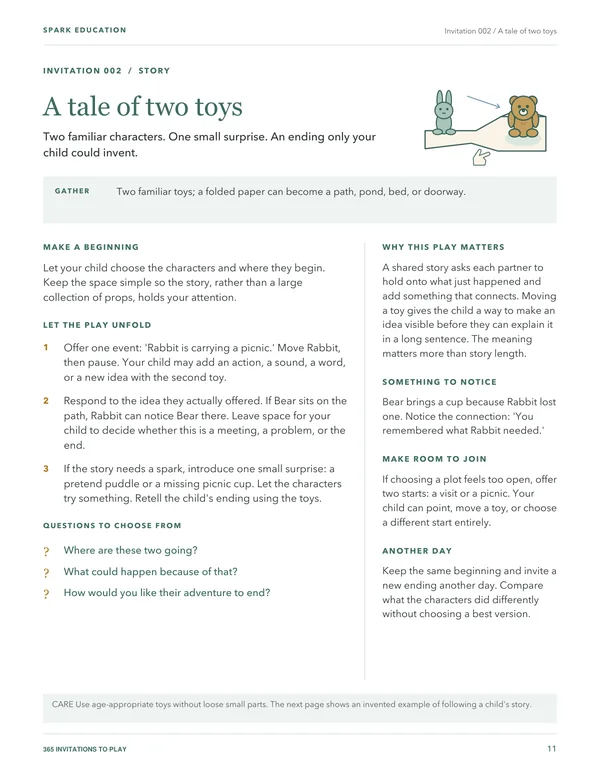
Comprehension grows dramatically when children step inside a story. After reading a favorite book, pull out two stuffed animals, wooden blocks, or toy vehicles and wonder aloud: "What if the little bear had to cross a block bridge to find his snack?" Letting your child act out the beginning, middle, and ending—or invent a hilarious new twist—exercises narrative sequencing and memory far better than comprehension quizzes.
6. Tactile letter play in dough, chalk, or bath foam
When your child shows interest in letter shapes—especially the letters in their own name or a favorite family member’s name—keep it hands-on and sensory. Roll play dough into long "snakes" to curve into an S or C, trace giant letters on the driveway with a wet paintbrush, or draw shapes in a shallow baking tray dusted with cornmeal. Large, full-arm and finger movements imprint letter forms far more comfortably than tight worksheet lines.
7. Cozy, face-out book baskets within reach
You do not need a huge home library—five or six rotating library books propped cover-facing-out in a low basket invite far more independent browsing than a tightly packed high shelf. When children can see illustrations at eye level, they naturally pick up books on their own, turn pages carefully, and "read" familiar pictures aloud to their toys.
Three small shifts that turn bedtime reading into a rich conversation.
Reading aloud together remains the single most joyful habit in early literacy, and HealthyChildren.org’s reading tips for families remind parents that reading should feel like play, not a chore. A few tiny tweaks—sometimes called interactive or shared reading—let your child become a co-storyteller:
- Pause on the pictures before turning the page: Point to a small detail in the corner and wonder aloud, "Look at the dog’s ears—how do you think he’s feeling right now?" or "What do you think might happen when she opens that door?"
- Occasionally trace a bold title or repeating refrain with your finger: You do not need to point to every word on every page (which can slow the magic of a story). Simply sweeping your finger beneath the title or a funny repeating line ("Brown bear, brown bear...") gently shows that those marks are where the words come from.
- Connect the story to your child’s real life: "Remember when we saw a muddy puddle like that at the park?" Bridging story events to real memories deepens vocabulary and shows children that books mirror their world—just as we explore in what children really learn in preschool beyond the finished project.
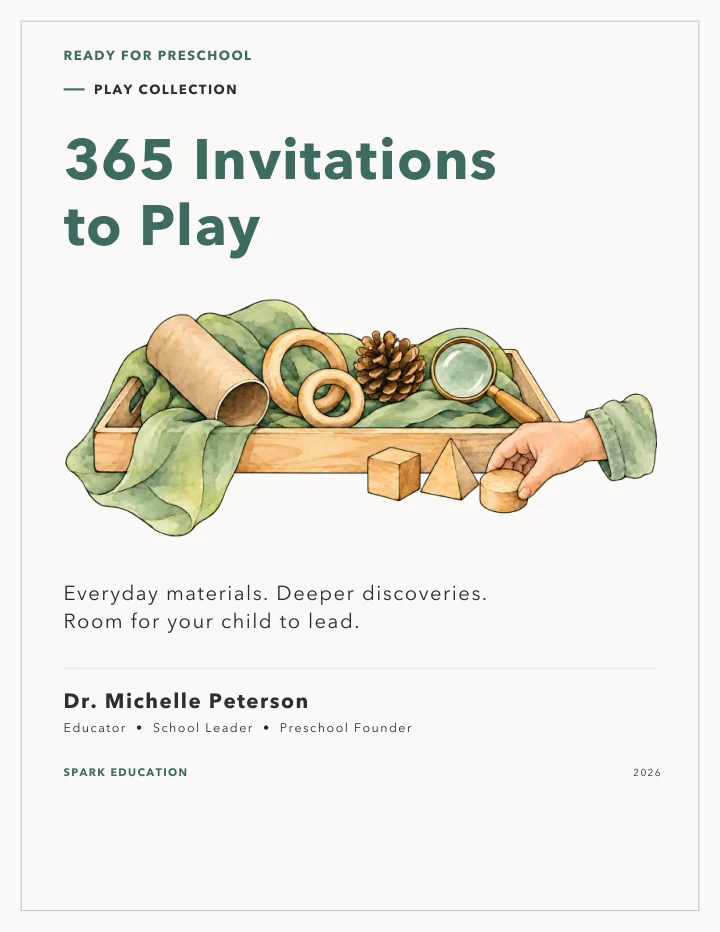
If you would like seven zero-prep home invitations ready to try this week—covering storytelling, sorting, movement, and everyday conversation using items already in your house—download our free A Week of Preschool Play — PDF, 10 pages. It is a free sample from Dr. Michelle Peterson’s 429-page digital book, 365 Invitations to Play ($14.95), which gathers 365 open-ended play ideas across 52 themes. Families building both playful home routines and preschool readiness can also view all five printable guides together in the Preschool Play & Readiness Collection ($24.95, saving $23.80).
Questions families ask about preschool early literacy.
Does my child need to know all 26 letters and letter sounds before kindergarten?
No—and memorizing isolated letters is only one small piece of readiness. Kindergarten teachers love welcoming children who listen to stories with curiosity, recognize their own name, enjoy rhymes and conversation, ask questions, and feel confident trying new things. If you want a grounded look at whole-child readiness alongside teacher conversations, explore our Kindergarten Readiness Checklist and guide on how to talk with your child’s teacher.
My preschooler wants the exact same picture book ten nights in a row—should I hide it?
Keep reading it whenever you have the energy! Repetition is a superpower for three- to five-year-olds. Each time they hear a familiar story, their brain stops working so hard to figure out what happens and starts noticing new vocabulary, rhyming patterns, visual details, and sentence rhythm. When they begin reciting a page from memory while looking at the pictures, they are practicing emergent reading in real time.
Is it okay to point out letter names at all if we skip flashcards?
Absolutely. Skipping flashcards does not mean hiding the alphabet—it simply means introducing letters inside warm, meaningful moments your child already cares about. Start with the letters that hold personal magic: the first letter of their name, M for Mom or D for Dad, or the letters on their favorite snack box or neighborhood sign.
What if my 3- or 4-year-old cannot sit still through a whole picture book?
That is very common, especially at age three. Let your child wiggle, sit on the floor with a quiet basket of blocks while listening, hold the book themselves, or jump straight to a favorite page. Five joyful minutes of talking about two pictures does far more for early literacy than twenty tense minutes of insisting they sit motionless until the final page. If you ever have broader questions about speech, listening, or language milestones, share your observations with your child’s pediatrician or preschool teacher.
See purposeful play in person.
At Spark Academy in Morton, Illinois, early literacy is woven naturally into every morning—from cozy read-alouds and storytelling in our Developmental Playroom to songs, conversation, and meaningful writing invitations during academic play. Central Illinois families are warmly invited to schedule a personal tour to see purposeful play in action.
The Spark Journal · Email Updates
Never miss a new Spark Journal article.
Get a short, thoughtful note from Dr. Michelle Peterson on Tuesdays and Fridays when new articles go live—practical ideas for the preschool years, straight to your inbox.
Try 7 Invitations Free · Families Everywhere
Bring purposeful play home—using what you already have.
Dr. Michelle Peterson’s 429-page digital book, 365 Invitations to Play, turns everyday household materials into meaningful moments of language, early math, and connection. Try a free week of seven invitations first.
Dr. Peterson’s complete PDF library · Paid PDF downloads you can read on screen or print selected pages: