The Spark journal · Learning Through Play
A calm restaurant table starts with what’s already in reach.
Waiting twenty minutes for dinner does not require a tablet or an overflowing tote bag. With a few playful invitations using napkins, menus, cups, and your voice, your 3- to 5-year-old stays curious and connected right at the booth.
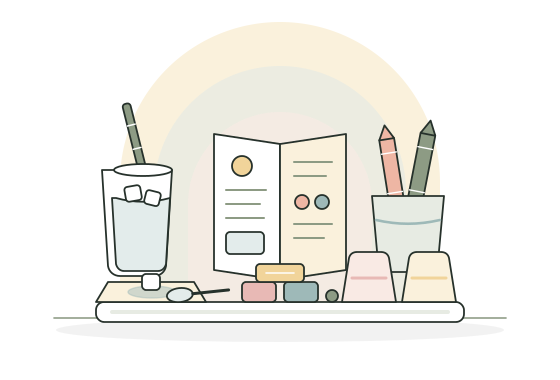
Picture a neighborhood booth at 5:45 PM. Menus have just been handed back to the server, water glasses have arrived, and the kitchen has a twenty-minute wait ahead. A four-year-old swings their heels gently against the vinyl bench, leans over to poke the salt shaker, and asks for the third time when the macaroni is coming. Across the table, an exhausted parent reaches into a pocket and wonders whether handing over a phone is the only way anyone is going to eat a warm meal tonight.
That booth scene is an illustrative example rather than a story about an individual student, and almost every family recognizes it. When preschoolers start wiggling, tapping silverware, or sliding under the table while waiting for food, they are not trying to give adults a hard time. Their bodies and developing brains are simply doing a very hard job: holding still in a loud, tempting room while hungry, with no concrete way to picture how long "ten more minutes" actually is.
The relief for parents is that keeping a three-, four-, or five-year-old engaged at a restaurant does not require hauling a twelve-pound backpack of crafts—or leaning on a glowing screen by default. What is already sitting on the table can turn the wait into genuine, unhurried play.
Why waiting at a restaurant feels so big for ages 3 to 5.
To an adult, twenty minutes before dinner is a chance to catch our breath. To a preschooler, twenty minutes in an unfamiliar room feels completely open-ended and physically demanding:
- Abstract time is invisible: Young children do not measure minutes on a clock. Saying "Just wait a little longer" gives their brain nothing to hold onto, whereas an event-based cue ("First we play two napkin games, then our bread arrives") makes waiting concrete.
- Hunger lowers frustration tolerance: Coming into a restaurant at the end of a busy day with an empty stomach means a child's self-regulation tank is already running low.
- Their brains are built for back-and-forth exchange: According to the Center on the Developing Child at Harvard University, young children's brains grow through serve and return—noticing what captures a child's attention and responding warmly with words, eye contact, and shared curiosity.
At ages three, four, and five, children are actively practicing the very skills that make shared meals possible. The CDC's Learn the Signs. Act Early. milestones highlight how three-year-olds begin carrying on conversations of two or more back-and-forth exchanges, four-year-olds dive eagerly into storytelling and pretend play, and five-year-olds practice taking turns and following simple game rules. A restaurant booth is actually one of the richest everyday settings to exercise those skills—when we give children an invitation that fits their developmental stage.
Why keeping screens tucked away helps both connection and appetite.
There is no shame in feeling tempted by a tablet or phone when everyone at the table is tired. Still, developmental and pediatric research gives families a reassuring reason to try playful table invitations first.
In a classic observational study published in Pediatrics (Radesky et al., 2014), researchers watched 55 caregivers eating with young children in fast-food restaurants. When adults became deeply absorbed in mobile devices, children often escalated their bids for attention, and distracted caregivers were more likely to respond sharply. Simply staying present—even for five minutes of silly table play—keeps that emotional loop warm and steady.
The American Academy of Pediatrics (AAP) and HealthyChildren.org family media guidance also recommend protecting media-free mealtimes. Beyond strengthening conversation and language, eating without a screen helps preschoolers pay attention to their food and notice internal cues of hunger and fullness rather than eating automatically while staring at a video.
A 10-second table example you can try tonight
Instead of saying, "Sit nicely and wait for dinner," look at what is already beside your plate:
- Set up the Ice-Cube Melt Check: Place one ice cube from your water glass onto a folded paper napkin beside a spoon.
- Make a simple prediction: "Look how dry the napkin is right now. When this ice cube melts, how big do you think the wet ring will grow before our food arrives—smaller than the spoon, or bigger?"
- Offer a gentle test: Invite your child to nudge the ice gently with the spoon or hold warm palms just above it (with adult supervision—never crunching hard ice) to see if warmth speeds up the melt.
In ten seconds, dead wait time becomes an experiment in cause, effect, and prediction—the heart of purposeful play using nothing you had to pack from home. (You can read the full illustrated version of this mission on our Spark on the Go page.)
Six zero-bag restaurant activities using what is already on the table.
When you leave the giant activity tote at home, your child's curiosity has more room to notice what is right in front of them. These six invitations require zero prep and fit neatly inside a booth:
1. Menu Picture & Letter Detective
Before handing menus back to the server, keep one open on the table between you. Tailor the hunt to your child's age:
- Ages 3–4: "Can you point to three red foods on this page?" or "Find something round like a wheel and something square like a block."
- Ages 4–5: "Let's hunt for the first letter of your name! Every time we spot it, we tap the table once."
Counting pictures, comparing sizes, and scanning left-to-right build early math and print awareness without feeling like a drill.
2. "What's Under the Cup?" Memory Slide
Ask for two empty paper cups (or fold two paper napkins into small tents). Place a wrapped mint, clean coin, or cracker packet underneath one cup while your child watches. Swap the two cups slowly once or twice, then ask: "Which cup is hiding the treasure?"
Let your child take a turn hiding the object while you guess—and make a delightfully dramatic wrong guess once in a while! Tracking a moving object strengthens working memory, one of the core executive function skills highlighted in the Harvard Center on the Developing Child executive function activities guide.
3. Table-Setting Pattern Builders
Gather three or four safe, dry items already in reach: wrapped oyster-cracker packets, sugar packets, folded napkin squares, or rounded spoons. Start a simple repeating pattern along the edge of your placemat—packet, spoon, packet, spoon—and pause with an open hand: "Hmm, what comes next in my pattern?"
Once your child finishes yours, invite them to build a pattern for you to solve. Patterning is foundational early math disguised as a tabletop puzzle.
4. Sugar-Packet Bridge & Tower Challenge
Wrapped sugar or sweetener packets make surprisingly sturdy mini building blocks (and are easy to return neatly to the caddy when food arrives). Challenge your child to build the tallest two-packet tower without toppling, or lay a spoon across two stacks to make a "bridge for a pea" or a tiny paper-napkin boat.
5. Booth-Sized Sensory "I Spy"
Classic "I Spy" gets stale quickly if you only name colors. Shift to clues about textures, sounds, and shapes across the dining room:
- "I spy something shiny that holds water."
- "I hear something sizzling or clinking—which direction is it coming from?"
- "I spy something soft that keeps our laps clean."
Sensory clues slow children down to notice details in their environment and give everyone at the table a chance to play together.
6. The Pass-Along Booth Story
Start a silly, four-sentence story right there in the booth and pass each next piece back and forth:
- You: "One rainy Tuesday, a tiny green frog hopped into this restaurant and asked the waiter for..."
- Your child: "Ten blue pancakes!"
- You: "When the pancakes arrived, the frog realized he forgot his fork, so he used..."
As Harvard's executive function research notes, group storytelling asks preschoolers to remember what was just said, wait for their turn, and add an idea that fits the thread—all while giggling at the absurdity.
If you want three tiny backups (without packing a giant bag).
Sometimes a restaurant wait stretches past twenty minutes, or you are dining out after a long travel day. You still do not need a bulky bag. Slipping just three flat, pocket-sized items into a coat pocket or small purse covers almost any long wait:
- A half-sheet of dot stickers or peel-off labels: Peeling tiny stickers from a backing sheet and placing them along a paper placemat strengthens the exact thumb-and-index pincer muscles explored in our guide to fine motor skills activities for preschoolers.
- A pocket stack of index cards and two triangular crayons: Triangular or broken crayons will not roll off slanted restaurant tables onto the floor every thirty seconds. Draw half a silly face, a simple road, or a treasure map and let your child finish the rest.
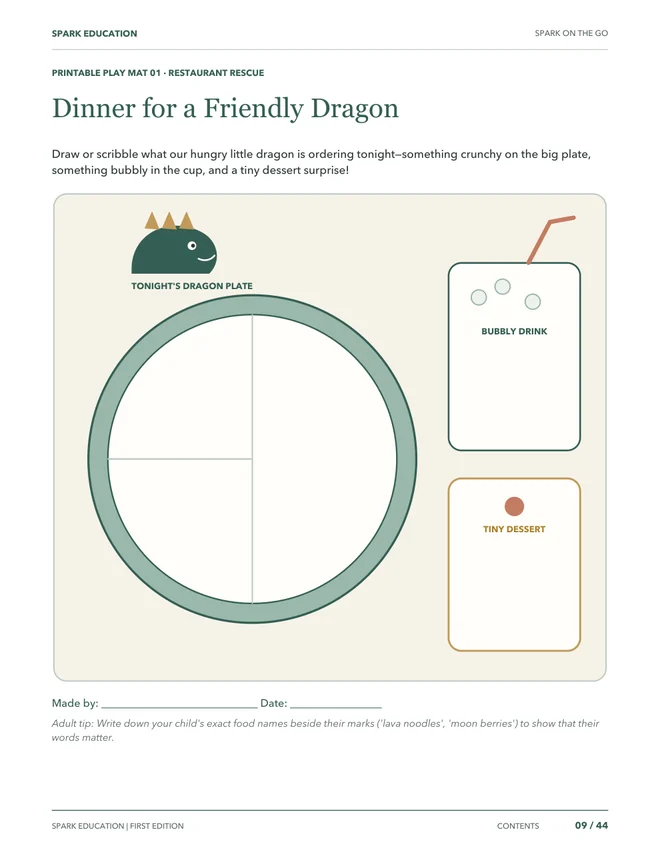
- One phone quick-sheet saved in your photos: Before you head out, download our free Spark on the Go Starter Pack — 10-page PDF. It includes five zero-prep play missions, two printable table mats (including Dragon's Silly Dinner Order), and a one-page phone quick-sheet you can screenshot and open with one thumb in ten seconds.
For families who eat out often or spend weekends running errands, the full 44-page Spark on the Go ($9.95) gathers 50 screen-free missions across five everyday settings—restaurants, grocery aisles, waiting rooms, car rides, and dinner prep—plus 10 printable play mats and 5 phone quick-sheets. And if restaurant transitions or leaving the booth sometimes trigger big feelings, Preschool Parenting Scripts ($4.95, 20 pages) offers calm, practical words to pair with limits—or you can explore all five family guides together in the Preschool Play & Readiness Collection ($24.95, saving $23.80).
You can also find gentle "exit lane" ideas for longer family meals in our post on navigating table waits and holiday gatherings.
Questions families ask about screen-free dining with preschoolers.
What should we do before sitting down so our preschooler is not already starving and restless?
Offer a small, steady snack—like a few apple slices, cheese cubes, or dry cereal—in the car before walking inside, or ask your server for water and bread, crackers, or fruit as soon as you sit down. Giving a three- or four-year-old five minutes to walk outside on the sidewalk while one adult checks in for the table also lets them release physical energy before sliding into a booth.
What if my preschooler simply cannot stay seated for an entire restaurant meal?
That is completely normal. Sitting quietly for 60 to 90 minutes exceeds the physical stamina of most three- to five-year-olds. Plan a calm movement break together: once you have ordered—or once your child has finished eating while adults linger—one parent can take a slow three-minute walk outside to spot birds, count parked cars, or stretch arms up to the sky before returning.
Is it a failure if we hand over a screen occasionally when everyone is exhausted?
Not at all. Family life includes sick days, delayed flights, and exhausted Friday nights. Keeping phones tucked away most of the time simply preserves screens as a rare, helpful tool rather than an automatic habit your child expects the moment they sit down at a table.
Do these tiny restaurant games actually support preschool readiness?
Yes. Waiting for a clue, taking turns adding to a shared story, matching shapes on a menu, and building a repeating pattern with cracker packets exercise working memory, flexible thinking, self-regulation, and conversational turn-taking—the exact foundational skills children bring into a play-based preschool classroom.
See purposeful play in person.
At Spark Academy in Morton, Illinois, our classrooms and monthly-rotating Developmental Playroom are intentionally designed to grow curiosity, conversation, and joyful self-regulation every day. Central Illinois families are always welcome to schedule a personal tour to see how purposeful play supports children ages 3 to 5.
The Spark Journal · Email Updates
Never miss a new Spark Journal article.
Get a short, thoughtful note from Dr. Michelle Peterson on Tuesdays and Fridays when new articles go live—practical ideas for the preschool years, straight to your inbox.
Free 10-Page Starter · Families Everywhere
Turn everyday errands and waits into screen-free play.
Spark on the Go packs 50 zero-prep play missions, 10 interactive mats, and 5 phone quick-sheets for restaurants, grocery aisles, waiting rooms, car rides, and cooking dinner. Download the 10-page starter PDF free.
Dr. Peterson’s complete PDF library · Paid PDF downloads you can read on screen or print selected pages: