The Purposeful Play Framework
Play with purpose. Grow with confidence.
A whole-child approach designed by Dr. Michelle Peterson, Ed.D., built on Experience Early Learning. Thoughtfully chosen play helps your child grow in learning, friendship, movement, and creativity.

Small moments. Real learning.
Build a tower.
Balance, spatial reasoning, and problem-solving grow with every block.
Tell a story.
Dramatic play gives children a reason to use language, share ideas, and see another point of view.
Sort a collection.
Noticing colors, shapes, and patterns becomes a foundation for mathematical thinking.
Their ideas lead the way.
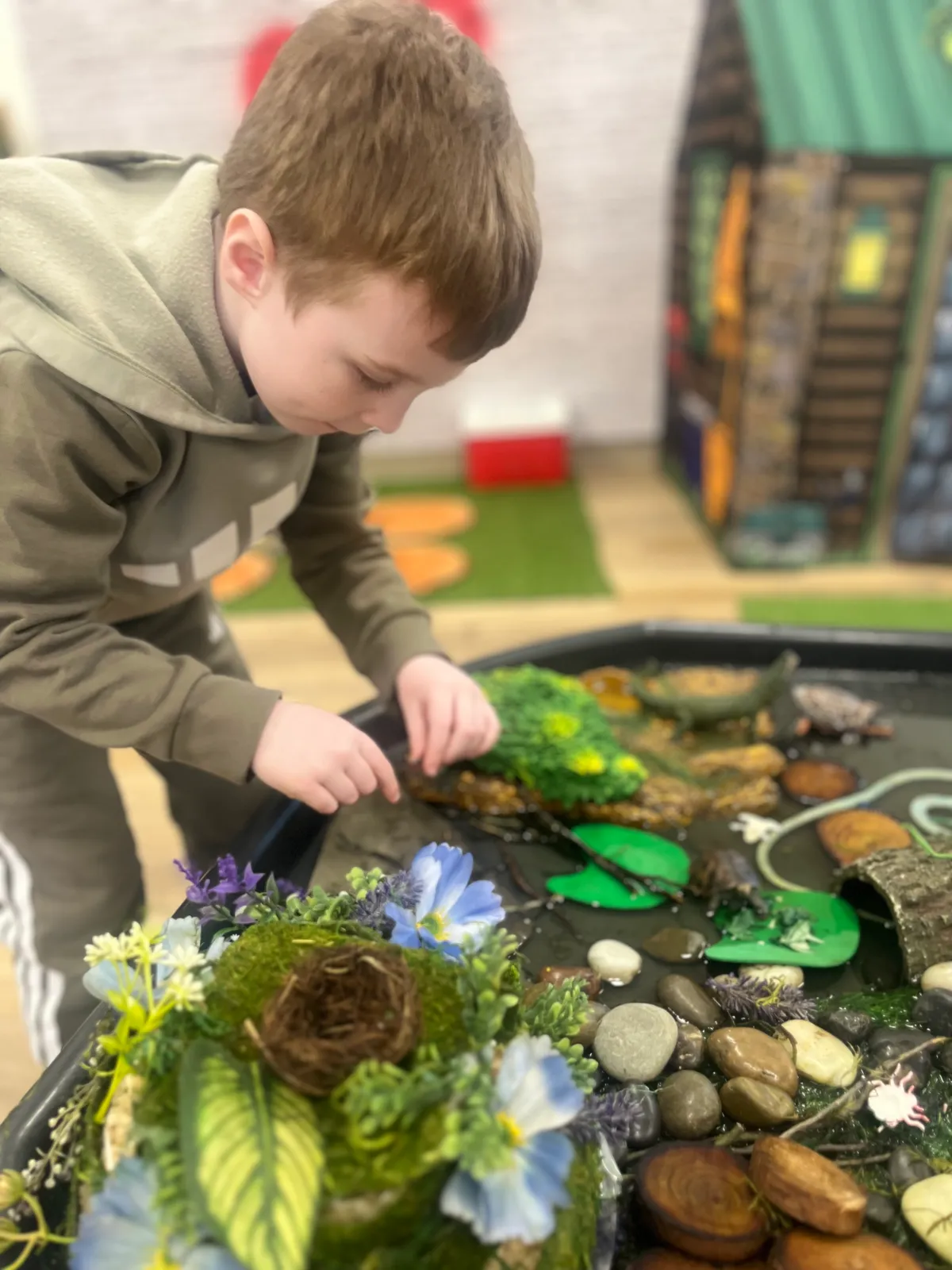
The Developmental Playroom becomes a new world each month: an ocean, a rainforest, a place to imagine. Teachers choose the environment with care. Your child chooses what to explore, what to create, and who to play with.
Thirty minutes each day to practice creativity, collaboration, and independent thinking.
Nine worlds to explore this year
- DinoLand
- Ice Castle
- Ocean Dive
- Space & Sky
- All About Me
- Global Passport
- Garden Treasures
- Weather & Seasons
- Explore the Rainforest
Each theme lasts approximately one month, connecting classroom learning and the playroom through shared ideas and materials.
Room for every kind of learning.
A familiar rhythm, with time to think, imagine, move, and connect.
- Academic Play
- 1.5–2.5 hours
- Teacher-guided play shaped around your child's learning goals.
- Developmental Playroom
- 30 minutes
- Child-led discovery in a changing monthly environment.
- Daily Enrichment
- 30 minutes
- A different subject each weekday. All included in tuition.
- Outdoor Play
- 15 minutes
- Movement, fresh air, and room for physical play.
- Snack & Transition
- 15 minutes
- Community, self-care, and everyday independence.
Enrichment, day by day
Monday: Spanish. Tuesday: STEM. Wednesday: Art. Thursday: Communication. Friday: Music & Movement. Your child enjoys the subjects offered on their attendance days, with no extra fees or supply lists.
Academic Play is 1.5 hours in the 3's and 4's programs, and 2.5 hours in Kindergarten Prep and Kindergarten.
Find your child's program and scheduleOne child. Their own path.
In classes of 10–12 with a 5:1 ratio, teachers notice where your child is ready for a challenge and where they need support. Ongoing assessment turns those observations into a learning plan that grows with them.
How we follow your child's progress
Experience Early Learning's formal developmental assessments cover cognitive, social-emotional, physical, and creative development. They inform daily planning throughout the year. You'll see daily photos and updates in Brightwheel and talk through formal assessments at parent-teacher conferences.
Connection before correction.
Behavior is communication. On a hard day, we look for the need or skill behind the behavior, help children name their feelings, and coach them through conflicts. Children are never shamed or labeled.
Meet the educator behind the frameworkA few questions, answered.
What is the Purposeful Play Framework?
Is this just play, or will my child learn academics?
How is the Purposeful Play Framework different from Montessori?
What assessment tools does Spark use?
What happens when my child has a behavior challenge?
Is enrichment (Spanish, STEM, etc.) included in tuition?
See purposeful play in action.
Come meet the teachers, explore the playroom, and see how a morning unfolds. Or ask us a question here—we'd love to talk.
Your information is private. We'll only use it to answer your question.
Prefer to call? 309-291-3292We may be in the classroom. Leave a message and we'll call you back the same day.