Skip to content

Their first school experience

Preschool readiness checklist

A gentle guide to the skills your child is beginning to use, and the support that can help.

A beginning, not a finish line.

Preschool readiness is about joining a group, communicating needs and exploring with support. Your child is still learning how to do all of these things.

Use the checklist as a conversation guide, not a test. Look for growing skills and talk with your child’s teacher about what helps them feel comfortable.

Five areas to notice.

Open an area to see the full list. These are general signs of growing independence, not Spark’s admission requirements.

01 / Social & emotional

Feeling safe with others

Watching other children, finding comfort with a teacher and joining a familiar routine.

See the 6 skills
  • Can separate from a parent or caregiver for a few hours without prolonged distress
  • Show interest in watching or playing near other children
  • Can follow a simple routine (snack time, circle time, cleanup)
  • Respond to their name when called by an adult
  • Are beginning to understand taking turns, even with reminders
  • Can recover from mild upsets with comfort from a trusted adult
02 / Communication

Letting someone know

Using words or gestures to ask for help, share a need or join a conversation.

See the 5 skills
  • Use words or gestures to express basic needs (hungry, thirsty, bathroom, help)
  • Be understood by adults outside the family at least some of the time
  • Understand and follow simple one- or two-step directions (“Put your shoes by the door”)
  • Show interest in books, songs, or being read to
  • Use at least 50 words or two-word phrases
03 / Self-care

Trying everyday tasks

Washing hands, eating a snack and taking small steps toward independence.

See the 5 skills
  • Are potty trained or making consistent progress toward it
  • Can wash and dry their hands with minimal help
  • Can attempt to put on shoes or pull up pants independently
  • Can eat a snack independently (unwrapping, using a cup)
  • Can sit for a short activity (five to ten minutes) with engagement
04 / Thinking & play

Following their curiosity

Pretending, building and exploring what a new material can do.

See the 5 skills
  • Show curiosity about new objects, activities, or environments
  • Engage in pretend play (feeding a doll, talking on a toy phone, playing house)
  • Can match or sort objects by one attribute (color or shape)
  • Enjoy building, stacking, or creating with blocks or art materials
  • Show sustained interest in an activity for a few minutes at a time
05 / Movement

Exploring with their whole body

Climbing, drawing, turning pages and handling play materials.

See the 5 skills
  • Walk, run, and climb with reasonable coordination
  • Hold and use a crayon or large marker
  • Turn pages of a book
  • Stack several blocks
  • Navigate stairs with support (holding a railing or adult hand)

Find support for their next step.

Share what you notice with an early childhood educator. A school visit can help you picture your child in the classroom and talk through a comfortable beginning.

If you have concerns about speech, social engagement or movement, talk with your pediatrician. You do not need to make the decision from a checklist alone.

More about readiness at three →

Two ways to begin at Spark.

Both programs require children to be at least three and fully potty trained by their first day.

Fresh 3’s Fridays

Fridays · 8:30–11:30 AM
$100 / month

Join when your child turns three, with rolling enrollment and no deadline. A full preschool morning with the same curriculum, teachers and daily rhythm; no more than 12 children.

Explore Fresh 3’s Fridays →

3’s Preschool

Mon/Wed or Tue/Thu · 8:30–11:30 AM
$350 / month

Two mornings each week for friendship, Academic Play, daily enrichment and the Developmental Playroom. A 5:1 student-to-teacher ratio leaves room for individual attention.

Explore 3’s Preschool →

Questions families ask.

What age can a child start preschool?

Most preschool programs accept children starting at age three, though some programs begin at two-and-a-half. At Spark Academy, the Fresh 3’s Fridays program starts on your child’s third birthday with rolling enrollment. The 3’s Preschool program requires children to be three by their first day of school.

Does my child need to be potty trained to start preschool?

Requirements vary by program. At Spark Academy, all students must be fully potty trained before their first day. If your child is still working toward potty independence, that is completely normal — it simply means waiting a bit longer before enrolling. Potty training readiness is often one of the clearest signals that a child is developmentally ready for the independence a preschool classroom requires.

What if my child cries at drop-off every time?

Some tears at drop-off are completely normal, especially during the first few weeks. The question is whether your child can settle within a few minutes and engage with the classroom. If crying is prolonged and your child cannot be comforted by teachers, it may be a sign they need a little more time before starting. A once-a-week program like Fresh 3’s Fridays can help ease the transition gradually.

How many days per week should a 3-year-old attend preschool?

For most three-year-olds, two or three half-days per week is a strong starting point. It provides enough consistency for learning routines and building friendships without overwhelming a child who is new to group settings. At Spark, the 3’s Preschool offers Tuesday/Thursday or Monday/Wednesday schedules for exactly this reason.

What is the difference between preschool readiness and kindergarten readiness?

Preschool readiness is about the foundational skills a child needs to benefit from a group learning environment for the first time — separation, basic communication, and emerging self-care. Kindergarten readiness builds on that foundation with more advanced expectations: letter recognition, counting, sustained attention, fine motor control, and greater social independence. Preschool is where those kindergarten-ready skills get built.

My child is shy — does that mean they’re not ready?

Not at all. Shyness and social readiness are different things. A shy child who observes other children with interest, can communicate needs to a trusted adult, and can separate from a caregiver is showing readiness — they just need a supportive environment that respects their temperament. Small class sizes and low student-to-teacher ratios (like Spark’s 5:1) make a significant difference for children who take longer to warm up.

What is the difference between preschool and daycare?

Daycare provides custodial care — a safe place for your child while you work. Preschool provides intentional early childhood education with a structured curriculum, credentialed teachers, and developmental goals. Some programs offer both. Spark Academy is exclusively a preschool: every minute of the day is designed around your child’s development, taught by degreed educators, and guided by the Purposeful Play Framework.

Come see the classroom.

Meet the teachers and talk about a beginning that fits your child.

A little guidance for the first big step.

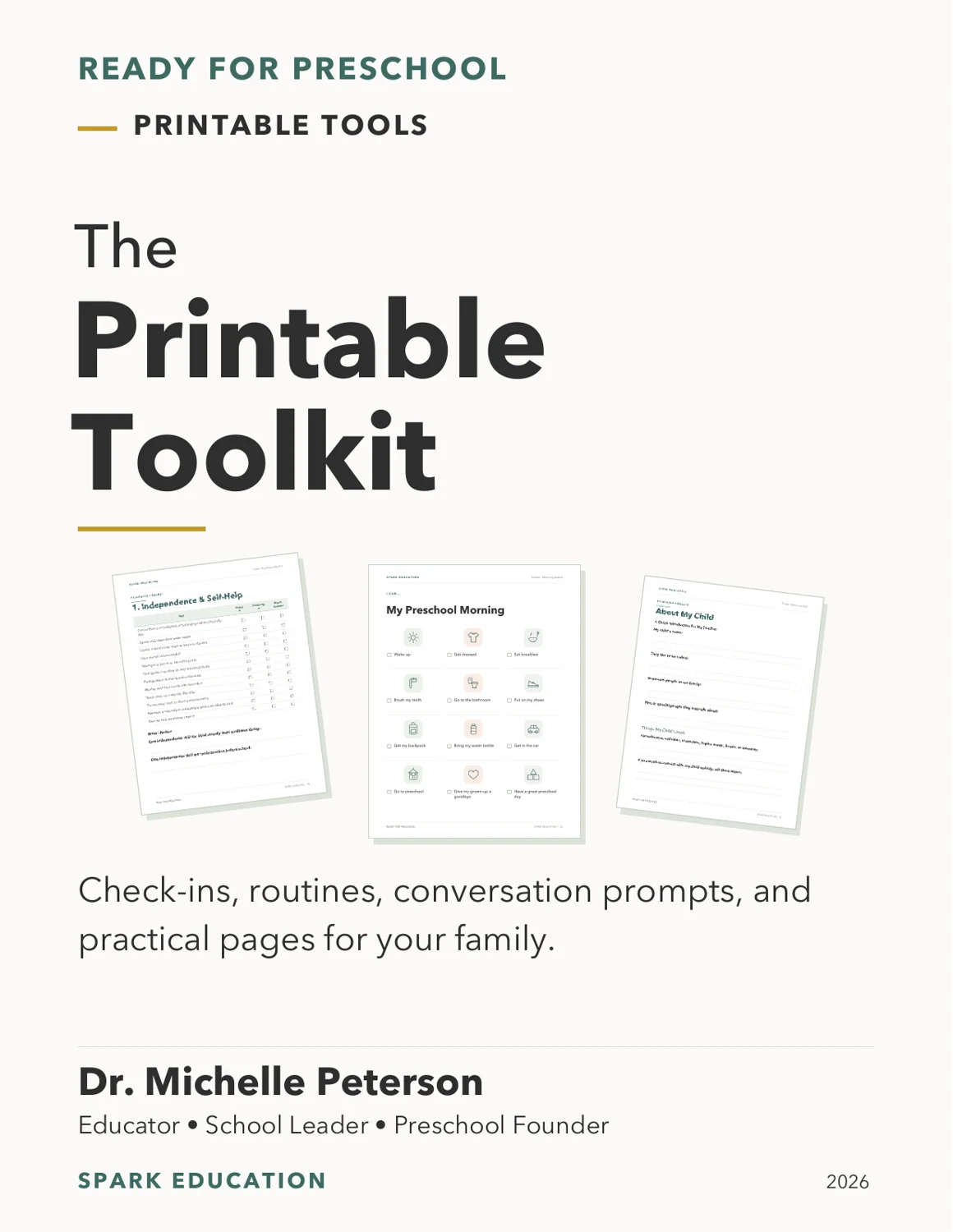
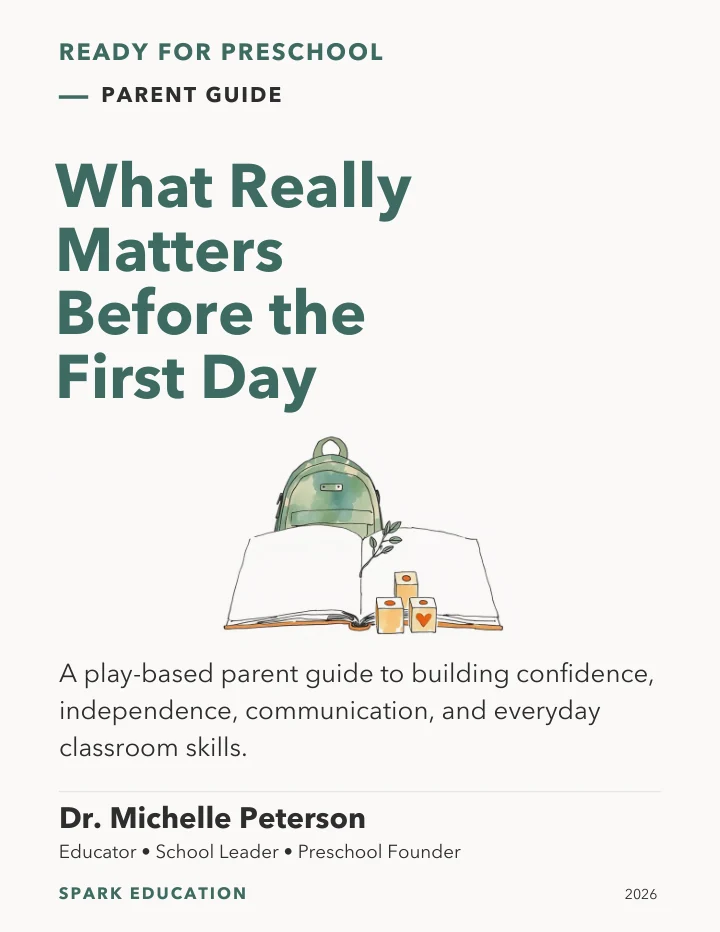
Ready for Preschool brings together Dr. Michelle Peterson’s illustrated parent guide and practical printables, with color and alternate print editions.

Explore the guide & printables

Readiness bundle $14.95. A free morning routine is available, too.

See all resources & free samples