Skip to content

The learning inside the play

What is play-based learning?

Children explore, imagine and experiment. Teachers make room for discovery and connect it with meaningful learning.

Curiosity, with a teacher’s purpose.

Play-based learning uses playful experiences to explore ideas and practice skills. A teacher chooses materials, observes closely, asks questions and offers help when it is useful.

Children have room to make choices. Teachers keep the learning in view.

Three ways a playful morning can unfold.

These are useful ways to describe play. A classroom can move between them, alongside direct teaching when it helps.

01

Free play

The child chooses the activity and direction. The teacher prepares a welcoming environment and stays attentive.

A classroom example

Classroom example: A child builds an elaborate “zoo” from blocks and figurines, inviting peers to buy tickets — practicing math concepts, language, and social skills without being told to.
02

Guided play

The teacher offers materials or a question with a learning goal. Children explore, make choices and test ideas.

A classroom example

Classroom example: The teacher fills the sensory table with objects of different weights and sizes and asks, “Which ones sink? Which ones float? Why?” Children develop scientific thinking through hands-on experimentation.

03

Structured play

The teacher leads a game or activity with shared rules. Children take part, practice and contribute ideas.

A classroom example

Classroom example: A teacher leads a rhythm and movement game where children clap a pattern, stomp a pattern, then create their own — building pattern recognition, auditory processing, and body coordination.

One bridge, many ways to learn.

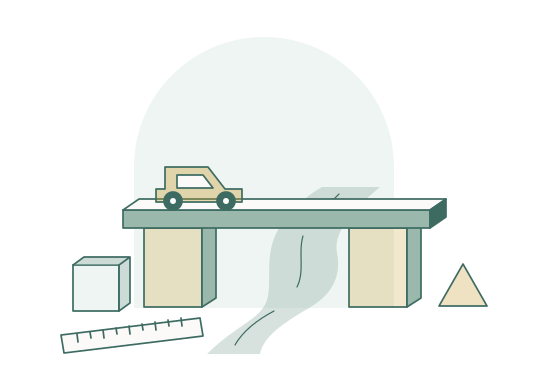
An example invitation: “Can we build a bridge for this little car?” A few blocks become a reason to plan, talk and try again.

Wooden blocks form a bridge over fabric, with a toy car and measuring strip.

Language

Explain the plan and describe what changed.

Math

Count blocks and compare height or length.

Cooperation

Share materials and decide what to try together.

Small-hand skills

Place, balance and adjust the pieces.

Planning

Remember the goal and change a step that did not work.

Creative thinking

Imagine another design and test it.

Research supports thoughtful choices.

NAEYC’s guidance supports playful learning and intentional teaching that responds to each child. It describes a range from child-directed exploration to direct instruction.

Read the research in context

Skene and colleagues’ 2022 review found specific benefits from guided play, with results varying across the skills studied. It does not establish that one approach wins on every outcome.

NAEYC’s teaching guidance emphasizes matching strategies to the child and the learning context. The quality of the teacher’s decisions matters.

Compare classroom approaches →

Look for the learning in the room.

On a visit, watch how teachers join children’s play. Ask what children are practicing and how the teacher knows when to offer a new challenge.

Eight things to look for
  • The classroom has distinct learning stations, not rows of desks
  • Teachers move through the room observing and scaffolding — not lecturing
  • The curriculum is intentional: every activity has a stated developmental purpose
  • Children have choice in some activities and structured time in others
  • Assessment is observation-based, not test-based
  • The program can explain how play connects to specific learning outcomes
  • Teachers have formal training in early childhood education or child development
  • Parents can visit the classroom at any time to see the approach in action
Spark’s Purposeful Play Framework →

Questions families ask.

Is play-based learning the same as “just playing”?

No. Play-based learning is an intentional educational approach where teachers design activities with specific developmental goals. Free play is one component, but the program also includes guided play (teacher-designed exploration) and structured play (teacher-led activities with rules). The teacher’s role is to plan, observe, scaffold, and assess — not to simply supervise.

Will my child learn academics in a play-based program?

Yes. A teacher can use building, stories, games and everyday materials to work on language, numbers, shapes and other academic ideas. Ask the program which learning goals it uses and how teachers observe each child’s progress.

What age is play-based learning most effective?

Play is an important part of learning throughout early childhood. NAEYC’s guidance covers children from birth through age eight and recommends teaching that fits their age, individual development and context. The balance of exploration, adult guidance and direct teaching changes with the child and the learning goal.

How is play-based learning different from Montessori?

Montessori is a specific educational approach with trained teachers, a prepared environment and specially designed materials. Play-based learning is a broader description of learning through playful experiences. Both can include child choice and hands-on exploration. Visit each school to understand its approach to materials, pretend play, group experiences and teacher guidance.

Will my child be ready for kindergarten after a play-based preschool?

Play-based preschool can help children practice the language, early math, social and everyday skills used in kindergarten. Readiness is individual; no program can guarantee the same outcome for every child. Talk with your child’s teacher about progress and use our Kindergarten Readiness Checklist to guide the conversation.

What does the research say about play-based vs. academic preschool?

Results depend on the approach, the quality of teaching and the skills measured. A 2022 review found advantages for guided play over direct instruction on some math and thinking measures, but not across all outcomes. Consider how a program combines purposeful play, clear learning goals and responsive teaching.

How do I know if a program is genuinely play-based or just using the label?

Ask to observe the classroom. In a genuinely play-based program, you will see learning stations (not rows of desks), children making choices, and teachers moving through the room asking questions and extending activities. Ask the program to explain how specific play activities connect to learning outcomes. If they cannot articulate the developmental purpose behind their activities, the label may be more marketing than practice.

Come see purposeful play.

Explore the classroom and the intentions behind a Spark morning.

Try a little play at home.

A few socks, two familiar toys, or room to move can become a beginning. Let your child’s idea guide what happens next.

365 Invitations to Play offers everyday starting points and ways to join in, from Dr. Michelle Peterson.