The Spark journal · Learning Through Play
Gifts that keep getting more interesting after December.
When a toy does less of the talking, your preschooler gets to do more of the thinking, building, and storytelling.
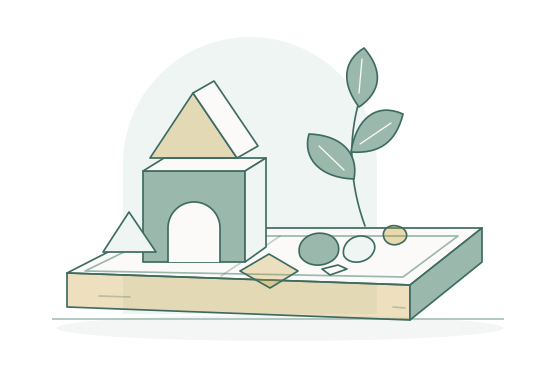
Picture two gifts unwrapped on a winter morning. One has buttons that announce colors, play a tune, and flash lights in the exact same sequence every time it is pressed. By afternoon, a three-year-old has discovered everything it can do. Across the rug sits a basket of wooden blocks, a roll of painter’s tape, and four small animal figures. Over the next three weeks, those same pieces become a veterinary clinic, a bridge over a taped river, and a bakery counter.
That contrast is an illustrative example rather than a story about a particular student, and it highlights a helpful rule of thumb for holiday shopping: when a toy does 90 percent of the work, only 10 percent is left for your child’s imagination. When the material is simple and adaptable, your preschooler brings the story, the problem-solving, and the conversation.
In its clinical report, Selecting Appropriate Toys for Young Children in the Digital Era, the American Academy of Pediatrics notes that traditional, low-tech toys—blocks, pretend props, puzzles, and art materials—support rich caregiver-child interaction and active imagination in ways flashing or screen-based substitutes rarely match. Toys do not build skills on their own; they create inviting reasons for children to experiment, talk, and play alongside the people who care for them.
Use the “ten-ways” lens before adding to your list.
Before choosing a gift for a three-, four-, or five-year-old, pause and ask one practical question: Could my child use this in ten different ways over the next two years?
A single-purpose gadget usually has one right answer. An open-ended material has none—which means a three-year-old can stack magnetic tiles flat on a baking sheet today, build a two-story garage at age four, and design symmetrical castles with a sibling at age five. NAEYC’s guidance on choosing toys for young children emphasizes materials that leave children in charge of the action and adapt as their thinking grows more complex.
Consider what happens when an adult sits beside a child with a tape road and a handful of blocks: “Your delivery truck is wider than the bridge—what could we try?” One small obstacle invites spatial reasoning, new vocabulary, frustration tolerance, and shared pride without feeling like a lesson.
Five gift categories that grow from age 3 to 5.
You do not need an overflowing playroom or expensive specialty sets to support play-based learning. Choosing one or two durable items from categories your child does not already have often brings far more sustained play than a pile of novelty toys.
1. Builders and spatial problem-solvers
- Solid wooden unit blocks or hollow blocks: Heavy enough to give real feedback about balance, gravity, and symmetry.
- Magnetic tiles or interlocking planks: Quick for small hands to connect into enclosures, ramps, and tall towers that invite testing and rebuilding.
- Everyday additions: Keep sturdy shipping boxes, cardboard tubes, and low-tack painter’s tape nearby so children can connect their blocks to roads, tunnels, and room-sized cities.
2. Small-world figures and pretend-play props
- Simple animal, family, or community figures: Unscripted figures without batteries let your child supply every voice and plot twist.
- Open-ended dress-up pieces: Play silks, cotton scarves, aprons, hats, a toy stethoscope, or a small canvas tote bag can become twenty different roles—unlike a rigid character costume tied to a single movie script.
- Play kitchen or market basics: A few metal bowls, wooden spoons, and felt or wooden foods invite menus, turn-taking, and early counting (“Two muffins for you, two for me”).
3. Process-art and hand-strength makers
- Play dough with real tools: Pair homemade or store-bought dough with a small wooden rolling pin, child-safe blunt scissors, cookie cutters, and natural loose parts (shells or large pasta shapes for ages without mouthing concerns) to strengthen the small hand muscles used later for writing.
- Blank paper, chunky crayons, and washable watercolors: Skip pre-printed coloring books once in a while in favor of heavy blank paper, washable tempera paint sticks, and masking tape. As we share in what children learn beyond the finished project, choosing colors and testing marks matters far more than making a picture look like an adult sample.
4. Real-world tools sized for preschoolers
- Kitchen helpers: A child-safe wavy nylon knife for slicing bananas, a small whisk, or color-coded measuring cups turn snack prep into meaningful family work.
- Outdoor explorers: A shatter-resistant magnifying glass, a small metal watering can, a bug viewer, or sidewalk chalk encourage children to slow down and investigate the yard in every season.
5. Cooperative games and conversation-rich books
- First cooperative board games: Games where players work together—getting animals to the barn before nightfall or matching hidden pictures as a team—let preschoolers practice waiting for a turn and following rules without the tears of early elimination.
- Wordless or richly illustrated picture books: Stories with expressive illustrations invite your child to "read" the pictures back to you, predict what a character is feeling, and notice new details on the tenth rereading.
When shopping for households with babies or toddlers alongside a preschooler, check HealthyChildren.org’s AAP toy safety checklist for small-part choking hazards, secure battery compartments, and sturdy non-toxic finishes.
Clutter-free gifts for grandparents, travel, and winter afternoons.
Many families reach November hoping for fewer plastic bins on the floor and more calm, connected moments together. When grandparents or relatives ask what would genuinely help, experiences and practical play invitations make wonderful gifts:
- Memberships and local outings: A children’s museum pass, zoo membership, swim lessons, or a "date coupon" for hot cocoa and a library trip together.
- Spark Academy Tuition & Enrichment Gift Cards: For grandparents gifting toward a grandchild’s preschool or kindergarten tuition—or families sharing Fresh 3’s Fridays, Camp Play, or Enrichment with a friend—our Spark Academy Gift Cards ($25–$10,000) let the recipient family decide how to use the credit, include an instant print-at-home certificate (plus optional physical card pickup or USPS mail), and never expire.
- Local Morton experience pass (Spark × Main Street Play Cafe): For Central Illinois families and grandparents, our Main Street Play Cafe 5-visit punch card gives five open-play admissions for $50 ($75 value, valid through December 31, 2027), slips right into a Christmas card or stocking, and puts 100% of every purchase toward building a miniature Spark Academy preschool storefront inside their Morton play town.
- A ready-to-go "invitation basket": Pair one modest gift—like a tub of play dough, a roll of colored painter’s tape, or a watercolor set—with printed activity cards so an adult never has to search a phone for ideas on a snowy Tuesday.
- Free holiday travel & home samplers: Before heading out on winter road trips, airport waits, or restaurant dinners, print our free Spark on the Go Starter Pack — PDF, 10 pages (five zero-prep play missions, two interactive mats, and a phone quick-sheet), or grab A Week of Preschool Play — free PDF, 10 pages for seven low-prep home invitations.
- Giftable digital guides from Spark: For families who want a full year of screen-free ideas without adding shelf clutter, our paid digital downloads include 365 Invitations to Play ($14.95, 429 pages across 52 themes), Spark on the Go ($9.95, 44 pages for waits, errands, car rides, and cooking dinner), or the complete five-guide Preschool Play & Readiness Collection ($24.95, saving $23.80 off the separate guides). Read on screen or print only the US Letter pages you need.
Questions families ask about holiday gifts for preschoolers.
How can we kindly steer relatives away from loud electronic toys?
Give specific, easy-to-buy alternatives across several price points—such as a $10 roll of rainbow painter’s tape and blank sketchpad, a $15 cooperative card game, or an add-on pack of magnetic tiles that expands a set your child already loves. Framing it around what your child is excited to build right now keeps the conversation warm and appreciative.
What if loud or flashing toys still arrive during the holidays?
Receive the giver’s generosity warmly first. At home, you can keep high-stimulation toys in a closet bin for occasional short turns, place a piece of clear tape over an overly loud speaker, or remove the batteries so a plastic fire truck becomes a vehicle powered by your child’s own sound effects and story.
Why does my preschooler ignore a room full of new toys after two days?
Too many visible choices at once can overwhelm a young child’s attention, leading to quick dumping rather than deep play. Try setting out just three or four open-ended options after the holidays and tucking the rest into a closet bin to rotate out a few weeks later—returning toys often spark fresh curiosity in January and February.
Do brain-building gifts have to cost a lot?
Not at all. Some of the richest materials for ages three to five cost just a few dollars: measuring spoons with dry oats, cardboard boxes with washable markers, clothespins on the edge of a shoebox, or kitchen funnels in a warm bath. Your unhurried presence for ten minutes at the start of play matters far more than the price tag.
See purposeful play in person.
At Spark Academy in Morton, Illinois, our classrooms and monthly-rotating Developmental Playroom are thoughtfully arranged with open-ended materials that invite curiosity, collaboration, and joyful discovery every morning. Local Central Illinois families are always welcome to schedule a personal tour and see how purposeful play shapes our preschool and kindergarten mornings.
The Spark Journal · Email Updates
Never miss a new Spark Journal article.
Get a short, thoughtful note from Dr. Michelle Peterson on Tuesdays and Fridays when new articles go live—practical ideas for the preschool years, straight to your inbox.
Try 7 Invitations Free · Families Everywhere
Bring purposeful play home—using what you already have.
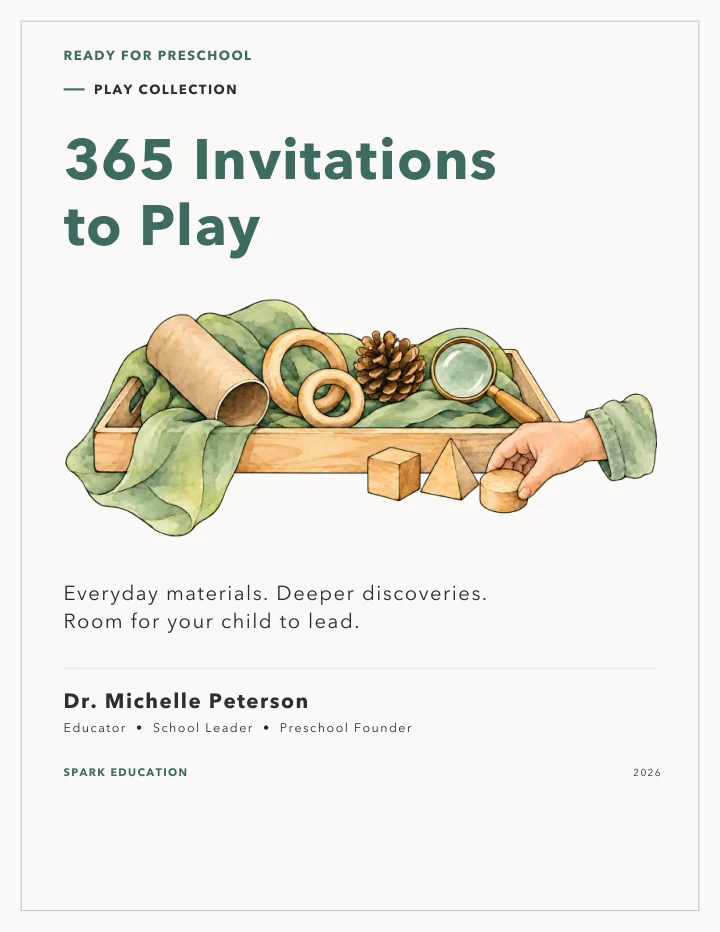
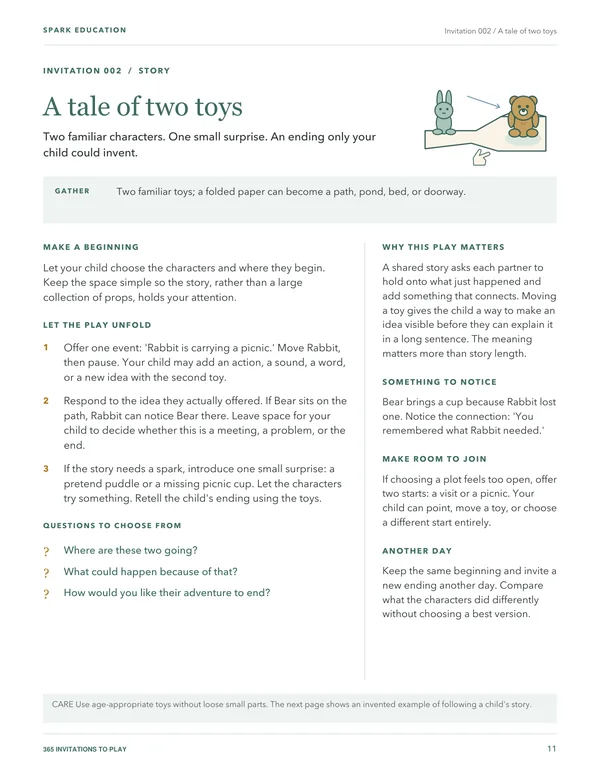
Dr. Michelle Peterson’s 429-page digital book, 365 Invitations to Play, turns everyday household materials into meaningful moments of language, early math, and connection. Try a free week of seven invitations first.
Dr. Peterson’s complete PDF library · Paid PDF downloads you can read on screen or print selected pages: