Preschool tax benefits, explained.
How the Child and Dependent Care Credit and 2026 Dependent Care FSA rules work for preschool families—and what records to keep.
When families sit down each fall or spring to map out their preschool budget, one practical question almost always lands near the top of the notepad: Is preschool tax deductible?
The short, honest answer is that preschool tuition is not a standard itemized tax deduction—but qualifying preschool expenses can unlock significant federal tax savings through two separate benefits: the Child and Dependent Care Tax Credit (claimed on IRS Form 2441) and an employer-sponsored Dependent Care Flexible Spending Account (FSA).
Even better for families budgeting for 2026: federal legislation enacted in 2025 introduced major permanent upgrades to both benefits starting in tax year 2026, including a higher $7,500 Dependent Care FSA limit and an expanded up to 50% credit rate on Form 2441. Because many older articles online still cite the pre-2026 limits ($5,000 FSA and 35% maximum credit), knowing the current 2026 rules can save you real confusion—and potentially hundreds of dollars—when you meet with your tax professional or choose workplace benefits during open enrollment.
Note: This guide provides general educational information to help you organize your records and ask sharper questions. It is not personalized tax advice; always confirm your specific filing situation with a qualified tax professional.
Start with three IRS distinctions that decide eligibility.
Before looking at dollar limits or percentages, the IRS applies three foundational rules to preschool expenses. Understanding them up front keeps you from counting on a tax break that does not match your household’s situation.
1. The care must enable you to work (or look for work)
To qualify for either the federal care credit or a Dependent Care FSA, preschool must allow you—and your spouse, if you file jointly—to work or actively look for work. If one parent stays home full-time and is neither working, actively job-hunting, enrolled as a full-time student, nor physically or mentally incapable of self-care, preschool tuition generally will not qualify for federal dependent care tax benefits, even though the program is wonderful for your child.
Both spouses generally need earned income for the year (such as wages, salaries, or net self-employment income), though the IRS provides a special deemed-income rule when one spouse is a full-time student for at least five months of the year or is unable to care for themselves. See IRS Topic 602: Child and Dependent Care Credit for the full eligibility checklist.
2. Preschool counts as care; kindergarten counts as education
This distinction catches many families by surprise during the transition year. Under federal tax law, expenses for nursery school, preschool, or similar programs below the level of kindergarten are considered qualifying child care expenses—even when the program has a rich, structured curriculum.
Once your child enters kindergarten or higher grades, tuition for the school day itself is classified by the IRS as an education expense, not a care expense, and does not qualify for the Child and Dependent Care Credit or Dependent Care FSA reimbursement. However, if you pay separately for qualifying before-school care, after-school care, or summer day camp (such as Camp Play) for a child under age 13 so you can work, those separate care charges may still qualify. Review the IRS FAQ on kindergarten and dependent care expenses for the exact wording.
3. A tax credit and a pre-tax FSA work differently—and you cannot double-dip
A tax credit reduces the federal income tax you owe dollar-for-dollar (so a $900 credit lowers your tax bill by $900). A Dependent Care FSA lowers your taxable income before federal income and payroll taxes are calculated. You can sometimes use both benefits in the same year if you have multiple children and higher care costs, but you can never apply the same dollar of tuition to both. Every tax-free dollar reimbursed through an employer FSA reduces your eligible expense cap on Form 2441 dollar-for-dollar.
Two federal tax benefits to explore for 2026.
Both federal child care benefits changed meaningfully beginning in tax year 2026. Here is how each one works under current rules.
Benefit 1: The Child and Dependent Care Tax Credit (IRS Form 2441)
When you file your federal return using IRS Form 2441, you can calculate a credit based on qualifying care expenses for a child under age 13:
- Eligible expense caps: Up to $3,000 in qualifying expenses for one child, or up to $6,000 for two or more qualifying children.
- New 2026 credit percentage (up to 50%): Beginning in tax year 2026, the maximum credit rate increased permanently from 35% to 50% of eligible expenses (worth up to $1,500 for one child or $3,000 for two or more children at the lowest AGI tier).
- How the phaseout works in 2026: The credit percentage starts at 50% for households with Adjusted Gross Income (AGI) up to $15,000, steps down gradually across widened 2026 income brackets (for married couples filing jointly, scaling down to 35% at $150,000 AGI and down to the permanent 20% floor above $210,000; for single and head-of-household filers, reaching 35% at $75,000 and the 20% floor above $105,000). Even high-earning families keep at least the 20% rate on qualifying expenses not covered by an FSA.
- Non-refundable: The credit can reduce your federal income tax liability down to zero, but any unused credit beyond your tax owed is not paid out as a refund.
- Filing status: Married couples generally must file Married Filing Jointly to claim the credit (with narrow exceptions for legally separated spouses living apart, detailed in IRS Publication 503).
Benefit 2: Employer-Sponsored Dependent Care FSA (IRC Section 129)
If either parent’s employer offers a Dependent Care Flexible Spending Account (also called a DCAP), you can set aside pre-tax payroll dollars specifically for qualifying preschool and day camp expenses—saving federal income tax, Social Security and Medicare (FICA) taxes, and in most states, state income tax.
- New 2026 contribution limit: Beginning in tax year 2026, the statutory annual household limit increased permanently from $5,000 to $7,500 per household ($3,750 if married filing separately)—the first permanent increase in nearly four decades. (See the IRS notice on the 2026 dependent care benefits exclusion amount on Forms W-2 and W-3.)
- Check your employer’s plan document: Employers must formally adopt the higher $7,500 cap in their Section 125 plan, so confirm your company’s specific election maximum during open enrollment rather than assuming it updated automatically.
- Use-it-or-lose-it timing: Dependent Care FSA funds must be used for care provided during the plan year (or applicable grace period). Estimate carefully—especially if your child will transition from preschool into kindergarten partway through the calendar year!
A worked example: comparing the 2026 FSA vs. Tax Credit.
Numbers make these rules much easier to picture. Suppose a married couple filing jointly in 2026 both work, earn a combined AGI of $120,000 (22% federal marginal bracket + 7.65% FICA), and enroll their four-year-old in a five-morning preschool program costing $6,000 over ten monthly payments (matching Spark Academy’s 4’s Preschool five-day tuition).
Here is how the two options compare as an illustrative example:
- Option A — Using the 2026 Child and Dependent Care Credit alone (no FSA): Only the first $3,000 of one child’s tuition counts toward the Form 2441 cap. Under the expanded 2026 MFJ phaseout schedule, a household at $120,000 AGI falls in the 35%–39% tier (roughly 35%–40% depending on exact AGI step). At a 35% credit rate on $3,000, the credit lowers their federal tax bill by roughly $1,050.
- Option B — Using a 2026 Dependent Care FSA (if their employer adopts the $7,500 limit): They elect $6,000 pre-tax to match their full ten-month preschool tuition. Saving 22% federal income tax + 7.65% FICA + Illinois 4.95% state income tax (~34.6% combined marginal savings) saves roughly $2,076 in taxes across the year. Because their $6,000 FSA exclusion already exceeds the $3,000 Form 2441 single-child cap, they cannot also claim the credit—yet the FSA still leaves them roughly $1,000 ahead.
- When the Credit can beat the FSA: For lower-to-moderate-income families in the 10%–12% federal tax bracket—especially those qualifying near the 40%–50% credit tier—the expanded 2026 Form 2441 credit can easily outperform a pre-tax FSA. And families with two preschoolers spending more than $7,500 a year should ask their CPA whether coordinating both benefits makes sense.
If you are still comparing total annual tuition, deposits, and schedules across local programs before open enrollment, our guide to comparing full-year preschool costs walks through how to put every school on the same apples-to-apples budget sheet.
Keep your paperwork simple—and all in one folder.
You do not need a complicated accounting system to claim preschool tax benefits cleanly. Start one physical folder or cloud folder at the beginning of the school year and save four items:
- Your provider’s legal name, street address, and Taxpayer Identification Number (EIN/TIN). Form 2441 requires these details for every care provider you claim.
- An itemized tuition payment summary showing dates of care and amounts paid. Both the IRS and Dependent Care FSA administrators look for proof of when care occurred (not just when a check was written) and that the charges were for a qualifying child below kindergarten.
- Any employer Dependent Care FSA statements and your year-end Form W-2 (Box 10). Box 10 shows the total dependent care benefits your employer reported for the year, which your tax software or CPA enters directly onto Form 2441 Part III.
- Separate receipts for summer day camp or after-school care. If your child attends Camp Play or another qualifying day camp during summer breaks while you work, keep those receipts alongside your school-year tuition records. (Overnight camps never qualify; day camps generally can.)
Need a tuition summary or provider tax ID from Spark Academy?
If your family is enrolled at Spark Academy in Morton, contact us anytime to request our provider tax information and an itemized tuition payment summary for your records or FSA reimbursement:
- Phone: 309-291-3292
- Email: [email protected]
Prefer to call? We may be in the classroom—leave a message. We return calls on weekdays, usually the same day.
Common questions parents ask about preschool taxes.
Can part-time preschool qualify?
Yes—part-time schedules (such as two, three, or five mornings per week, or Fresh 3’s Fridays) can qualify as long as the care enables both working parents (or a working single parent) to work or look for work and your household meets the other IRS requirements. Full-time enrollment is not required by the IRS.
What about Kindergarten Prep vs. Kindergarten?
The IRS draws the line at kindergarten. Because Kindergarten Prep is a pre-kindergarten program below the level of kindergarten, qualifying work-related tuition for Kindergarten Prep is generally treated differently from Kindergarten tuition itself. Share the written program description and payment dates with your tax professional so they can classify each portion accurately—especially in a calendar year when a child moves from preschool into kindergarten in August.
Do registration deposits or included snacks and supplies disqualify tuition?
Generally, when snacks, supplies, and enrichment activities are bundled directly into a preschool’s all-inclusive care tuition below kindergarten, they are part of the overall care fee rather than a disqualifying separate charge. Application or non-refundable deposit fees that are required to enroll—and actually lead to your child attending—may be treated differently depending on timing and whether care was received; confirm how to report your deposit with your preparer.
What if one parent is a full-time student?
You may still qualify. Under IRS Publication 503, if one spouse is a full-time student for at least five calendar months of the year, the IRS treats that spouse as having earned income of $250 per month for one qualifying child (or $500 per month for two or more children) when computing the earned-income limit on Form 2441. Because the cap applies per month of full-time enrollment, review the exact calculation with your tax preparer.
Does Illinois offer a state child care tax credit or assistance?
Illinois does not currently offer a standalone state version of the federal Child and Dependent Care Credit, though contributing pre-tax through a Dependent Care FSA still reduces your Illinois state taxable income (saving Illinois’s flat 4.95% state income tax on every eligible dollar). Eligible Illinois families can also explore the Illinois Child Care Assistance Program (CCAP), which Spark Academy accepts for all five core programs—see our financial assistance guide for details.
Planning your family’s preschool year in Central Illinois?
At Spark Academy in Morton, our all-inclusive tuition covers teachers, curriculum, daily enrichment, school supplies, art materials, and daily snacks—so there are no surprise supply lists or mid-year fees when you build your budget. Local families can compare our core programs or schedule a personal tour to walk through schedules and tuition options together.
The Spark Journal · Email Updates
Never miss a new Spark Journal article.
Get a short, thoughtful note from Dr. Michelle Peterson on Tuesdays and Fridays when new articles go live—practical ideas for the preschool years, straight to your inbox.
Free Printable Sample · Families Everywhere
Put your school comparisons and daily routines on paper.
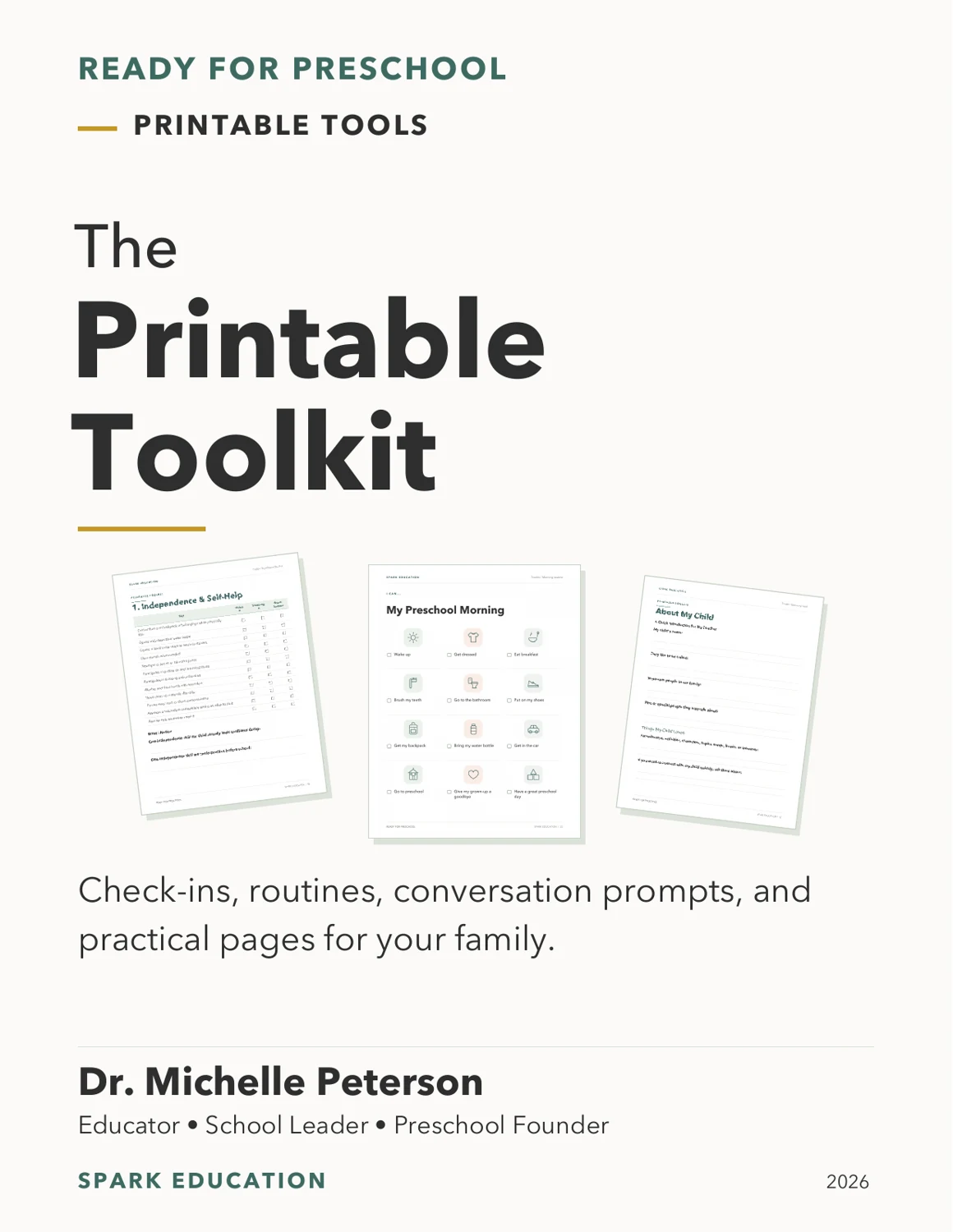
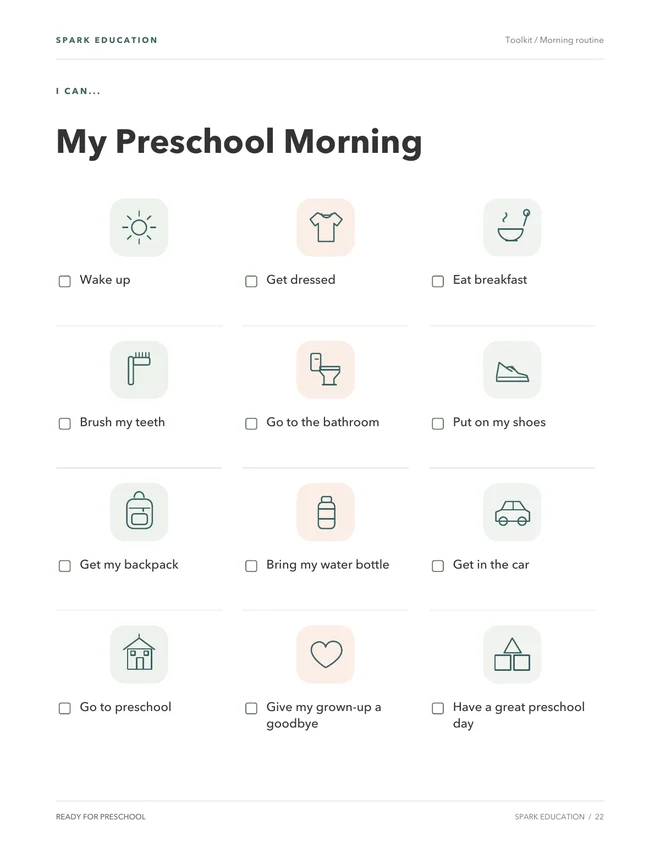
The Printable Toolkit includes 41 write-in pages—visual morning and bedtime sequences, school-visit worksheets, and teacher check-in planners from Dr. Michelle Peterson. Try the visual Morning Routine free.
Dr. Peterson’s complete PDF library · Paid PDF downloads you can read on screen or print selected pages: